
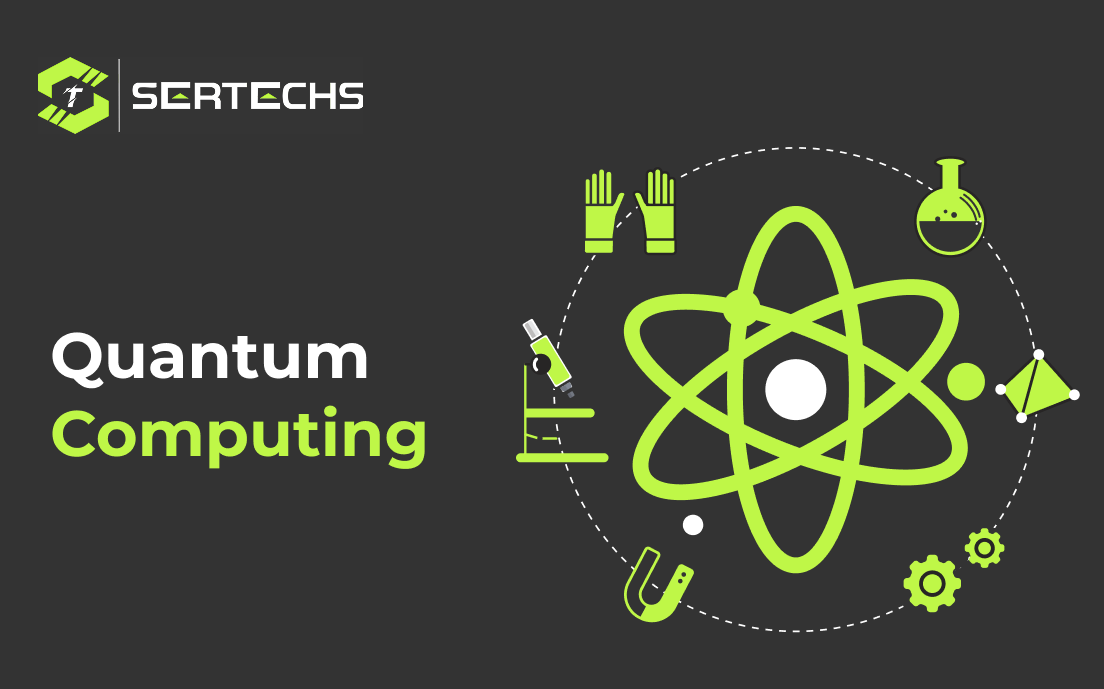
Quantum computing is an evolving field of study and technology that leverages the principles of quantum mechanics to process and manipulate information. Unlike classical computers that use bits as the fundamental unit of information (binary digits, representing 0 or 1), quantum computers use quantum bits or qubits.
Key principles and concepts in quantum computing include:
Qubits:
Qubits are the basic units of quantum information. Unlike classical bits that can be either 0 or 1, qubits can exist in a superposition of states, representing 0, 1, or any quantum combination of both simultaneously.
Superposition:
A qubit can exist in a superposition of both 0 and 1 states, allowing it to represent multiple possibilities at the same time. This is a fundamental property of quantum mechanics.
Quantum Gates:
Quantum gates are quantum analogs of classical logic gates. They perform operations on qubits to manipulate and transform the quantum states, enabling quantum computations.
Quantum Algorithms:
Algorithms designed to leverage the unique properties of quantum mechanics to solve specific problems more efficiently than classical algorithms. Examples include Shor’s algorithm for factoring large numbers and Grover’s algorithm for unstructured search.
Quantum Speedup:
Quantum algorithms can provide significant speedup for certain computational problems compared to the best-known classical algorithms. This is a key motivation for the development of quantum computing.
Quantum Circuit:
A representation of a quantum algorithm using quantum gates. Quantum circuits are analogous to classical circuits but operate on qubits.
Quantum Supremacy:
The point at which a quantum computer can perform a calculation or solve a problem that is fundamentally infeasible for a classical computer within a reasonable time frame.
Quantum Hardware:
Physical systems used to implement and operate quantum bits, such as superconducting qubits, trapped ions, and quantum dots.
Quantum computing is an active area of research and development, with the potential to revolutionize various industries by solving complex problems that are beyond the capabilities of classical computers. However, it is important to note that quantum computing is still in its early stages, and practical, large-scale quantum computers are yet to be realized.