
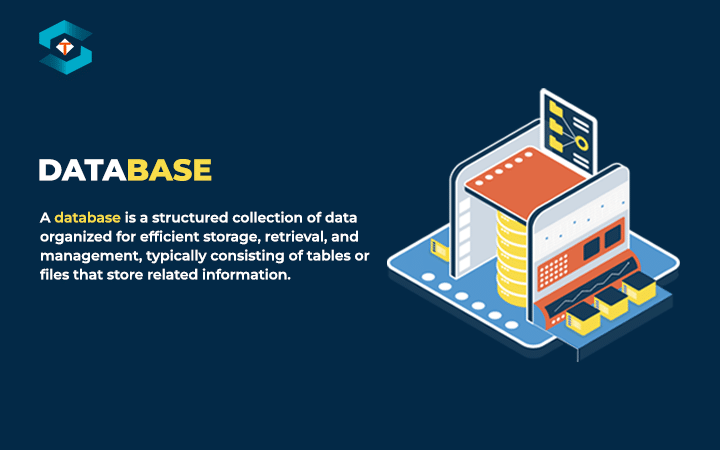
A database is a structured collection of data organized in a way that allows efficient storage, retrieval, and manipulation of information. It serves as a centralized repository for managing, storing, and organizing large amounts of data in a consistent and accessible manner. Databases are used in various applications and systems to support data management needs.
Here’s a detailed overview of databases, including their components, types, and key concepts:
Components of a Database:
Data:
Data are the facts, figures, and raw bits of information that are stored in the database. It could be text, numbers, images, audio, or any other type of information.
Database Management System (DBMS):
The DBMS is software that facilitates creating, managing, and manipulating the data. It provides an interface for users and applications to interact with the database.
Database Schema:
The database schema defines the structure of the database, including tables, relationships, constraints, and other elements that ensure data consistency and integrity.
Queries:
Queries are commands or requests made to the database to retrieve or modify data based on specific criteria.
Tables:
Tables are the basic building blocks of a database. They organize data into rows and columns, allowing for efficient storage and retrieval.
Indexes:
Indexes are structures that enhance the performance of queries by enabling quick access to specific data within a table.
Types of Databases:
Relational Databases:
Relational databases organize data into tables with predefined relationships between them. They use SQL (Structured Query Language) for querying and managing data.
NoSQL Databases:
They are non-relational and can handle a wide variety of unstructured, semi-structured, and structured data. They are often used in big data and real-time web applications.
NewSQL Databases:
NewSQL databases aim to provide the benefits of both relational and NoSQL databases by offering scalability and high performance without sacrificing consistency.
In-memory Databases:
In-memory databases store data in main memory (RAM) instead of on disk, resulting in extremely fast data retrieval and processing.
Graph Databases:
Graph databases are designed to represent and store relationships between data points as graphs, making them ideal for applications like social networks and recommendation engines.
Primary Key and Foreign Key:
A primary key uniquely identifies a record in a table, while a foreign key establishes a link between two tables based on a related field.
Transaction:
A transaction is a set of operations that are executed as a single unit. It must follow the ACID properties to maintain data consistency.
Backup and Recovery:
Backup involves creating copies of the database to protect against data loss, while recovery involves restoring the database to a consistent state after a failure.
Data Modeling:
Data modeling is the process of defining the structure of the data and the relationships between data elements, which helps in designing an efficient database schema.