
jQuery

jQuery is a fast, small, and feature-rich JavaScript library. It simplifies client-side scripting in HTML and is designed to make things like HTML document traversal and manipulation, event handling, and animation much simpler with an easy-to-use API that works across different browsers. Key features include: DOM Manipulation: jQuery simplifies interacting with the Document Object Model (DOM), allowing developers to easily select elements, modify their content, style, or attributes. Event Handling: It provides methods to handle various events on elements, such as click, hover, submit, etc., making event binding straightforward. AJAX Support: jQuery simplifies the process of making AJAX requests, allowing developers to fetch data from a server without having to reload the entire page. Animations: It offers built-in animation effects and methods to create dynamic and interactive user interfaces. Cross-Browser Compatibility: It handles many cross-browser issues and inconsistencies, providing a consistent interface across different browsers. Plugins: jQuery has a vast ecosystem of plugins that extend its functionality, allowing developers to add complex features easily. Benefits of Using jQuery: Simplicity and Ease of Use: jQuery’s syntax is concise and easy to learn, making it accessible for developers, especially beginners. Enhanced Productivity: It simplifies common tasks, reduces the amount of code needed, and speeds up development time. Wide Adoption and Community Support: It has been widely adopted, leading to a large community of developers who contribute plugins, tutorials, and support. With the evolution of modern web standards, the need for jQuery has diminished in certain cases. Many functionalities provided by jQuery are now available through native browser APIs or modern JavaScript frameworks, which are optimized for performance and maintainability. jQuery gained immense popularity due to its ease of use, extensive documentation, and wide range of functionalities. However, with advancements in modern JavaScript and improvements in browser APIs, many features that they provided have become native functionalities in modern browsers. Still, it remains in use in legacy systems and for scenarios where its simplicity and concise syntax are preferred.
JavaScript Frameworks
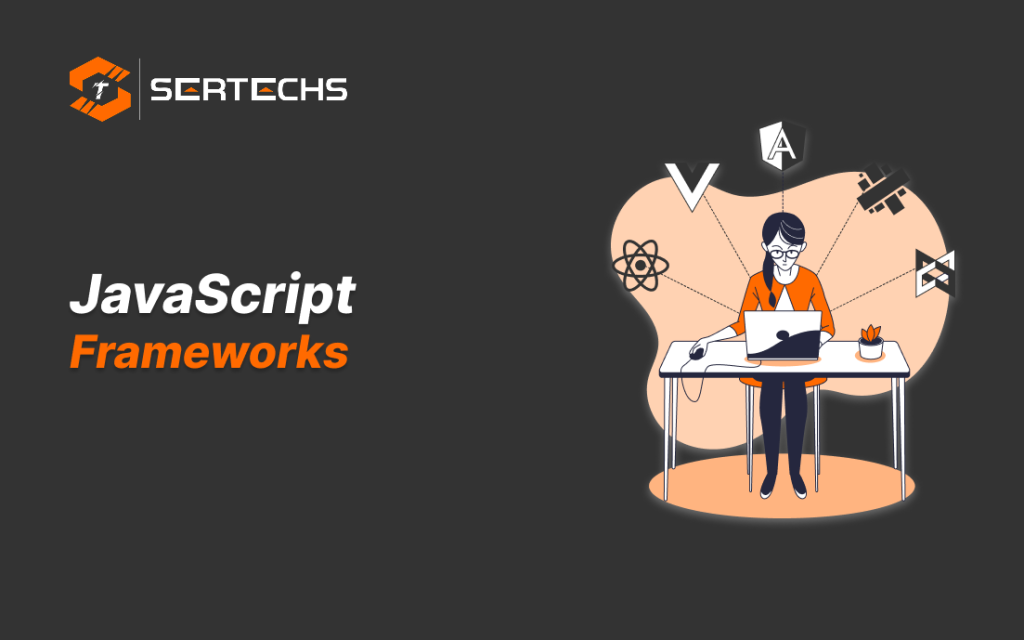
JavaScript frameworks are pre-written, standardized sets of code that help developers build web applications efficiently. They provide a structure for developers to create robust, scalable, and maintainable web applications by offering tools, libraries, and reusable components. It supports various data types such as numbers, strings, booleans, objects, arrays, functions, and more. It’s loosely typed, allowing variables to hold different types of data. Here are some popular JavaScript frameworks: React: Developed by Facebook, React is a widely used library for building user interfaces. It employs a component-based architecture and allows developers to create reusable UI components. Angular: Created and maintained by Google, Angular is a comprehensive framework for building web applications. It follows the MVC (Model-View-Controller) architecture and offers features like two-way data binding. Vue.js: Vue.js is a progressive JavaScript framework that is lightweight and easy to integrate. It focuses on the view layer and provides a flexible and approachable structure for building UIs. Node.js: Although not a traditional front-end framework, Node.js is a runtime environment that enables developers to run JavaScript code on the server-side. It’s commonly used for building scalable network applications. Ember.js: Ember.js is an opinionated framework that emphasizes convention over configuration. It provides a set of tools and practices to streamline the development process. Svelte: Unlike other frameworks, Svelte shifts the work from the browser to the build step. It compiles the code to highly efficient JavaScript during the build process, resulting in smaller bundle sizes and optimized performance. Backbone.js: This is a lightweight framework that provides the structure for building single-page applications by providing models, views, collections, and event handling. These frameworks and libraries have their strengths and weaknesses, and their suitability often depends on the specific requirements of a project, the development team’s familiarity, scalability needs, and the type of application being built. Developers often choose frameworks based on factors such as ease of learning, community support, performance, scalability, and flexibility.
JavaScript
JavaScript is a versatile programming language primarily used for creating dynamic content on webpages. Developed by Netscape as “LiveScript” in the mid-1990s, it was later renamed JavaScript. Despite the similar name, JavaScript has no direct relation to the Java programming language; they are different languages with distinct syntax and purposes. Here are some key aspects of JS: Client-Side Scripting: JavaScript is primarily employed as a client-side scripting language, running in a user’s web browser. It allows web developers to create interactive and dynamic elements within web pages. High-Level, Interpreted Language: JS is a high-level language, meaning its syntax is closer to human language and is relatively easy to read and write. It’s also an interpreted language, executed line-by-line without needing a compilation step. Event-Driven and Asynchronous: It is event-driven, meaning it responds to events such as user actions (clicks, inputs, etc.) or system-generated events. It’s asynchronous, allowing for non-blocking execution, crucial for handling tasks like fetching data from servers without stopping other operations. Used in Web Development: JavaScript is a fundamental part of modern web development. It is used to manipulate and modify HTML and CSS, create animations, handle user interactions, build web applications (including single-page applications), and much more. Supports Various Paradigms: It supports multiple programming paradigms, including procedural, object-oriented, and functional programming styles. This flexibility allows developers to choose the approach that best fits their project. Extensive Ecosystem: JS has a vast ecosystem with numerous libraries and frameworks like React, Angular, Vue.js, and Node.js, which extend its capabilities for various purposes, including front-end and back-end development. Cross-platform Language: It isn’t limited to web browsers anymore. With the help of runtimes like Node.js, developers can use JavaScript for server-side scripting, enabling them to build full-stack applications entirely in JavaScript. JavaScript is a fundamental technology for web development, playing a crucial role in creating modern, interactive, and responsive web applications. Its continual evolution and widespread adoption have made it an essential skill for developers.