
PHP Frameworks
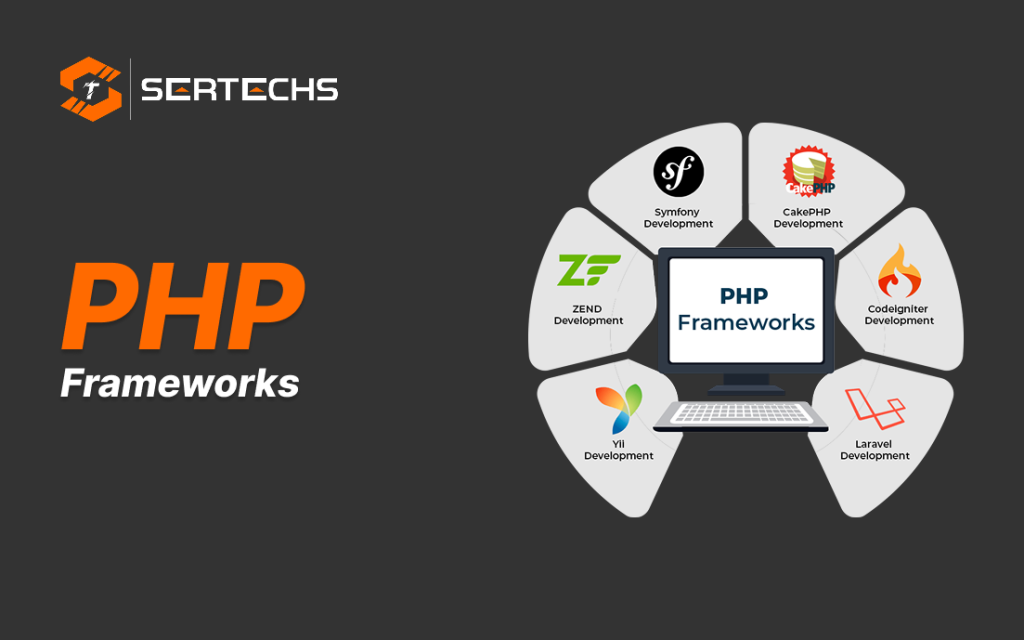
In PHP, a framework refers to a pre-built structure that provides a foundation for developing web applications. Frameworks in PHP offer a set of tools, libraries, and reusable components to facilitate the development process, allowing developers to build applications more efficiently by following predefined patterns and best practices. Some popular PHP frameworks include: Laravel: Known for its elegant syntax and expressive features, Laravel is one of the most widely used PHP frameworks. PHP frameworks are essential tools for web developers that provide a structured foundation for building web applications. It offers a robust set of tools for building web applications, including routing, authentication, database ORM (Object-Relational Mapping), and more. Symfony: This framework provides a set of reusable PHP components and libraries. It’s highly customizable and suitable for creating both small-scale and large-scale applications. CodeIgniter: Known for its simplicity and small footprint, CodeIgniter is lightweight and straightforward to use. It’s suitable for developers who prefer a simpler structure and need to build applications quickly. Yii: Yii is a high-performance PHP framework known for its speed and security features. It follows the DRY (Don’t Repeat Yourself) principle and offers features like scaffolding, caching, and authentication. CakePHP: CakePHP is a robust framework that follows the convention-over-configuration principle. It simplifies the development process by reducing the need for configuration, enabling developers to focus more on the application logic. Zend Framework (Laminas Project): Now known as the Laminas Project after rebranding, it’s a collection of professional PHP packages suitable for enterprise-level applications. It offers a high degree of flexibility and follows modern PHP development practices. These frameworks provide various features like routing, database abstraction, templating engines, security mechanisms, and more, helping developers to build secure, scalable, and maintainable web applications. The choice of framework often depends on project requirements, developer familiarity, scalability needs, and the specific features offered by each framework.
Laravel
Laravel is an open-source PHP web application framework known for its elegant syntax and ease of use. It was created by Taylor Otwell and released in 2011. Laravel follows the model-view-controller (MVC) architectural pattern, which separates the application logic from the presentation layer, making development more organized and manageable. Key features include: Eloquent ORM (Object-Relational Mapping): It provides a beautiful, simple ActiveRecord implementation for working with databases. It allows developers to interact with the database using PHP objects and avoids writing complex SQL queries. Blade Templating Engine: Blade is a lightweight and powerful templating engine provided by Laravel. It enables developers to create reusable, clean, and intuitive views. Routing: It offers a simple and expressive way to define routes. Routes define the URL structure of the application and map them to appropriate controllers and actions. Middleware: Middleware provides a mechanism to filter HTTP requests entering your application. It allows for handling tasks such as authentication, logging, etc., before and after the request reaches the intended route or controller. Authentication and Authorization: Laravel makes authentication implementation easy with pre-built authentication scaffolding. Additionally, it provides a straightforward way to organize access control logic and permissions. Artisan Console: Laravel includes a built-in command-line interface called Artisan. It assists developers in performing repetitive tasks, such as creating controllers, models, migrations, and more. Testing: Laravel supports testing out of the box with PHPUnit. It provides convenient methods for testing applications and running tests to ensure the codebase’s stability. Security: Laravel takes security seriously and provides various built-in security features to protect against common web vulnerabilities, such as CSRF (Cross-Site Request Forgery), XSS (Cross-Site Scripting), SQL injection, and more. The Laravel ecosystem also includes various official and community-driven packages that extend the framework’s functionalities. Laravel has gained immense popularity due to its robust features, a supportive community, comprehensive documentation, and its ability to streamline the development process for web applications of varying complexities.