
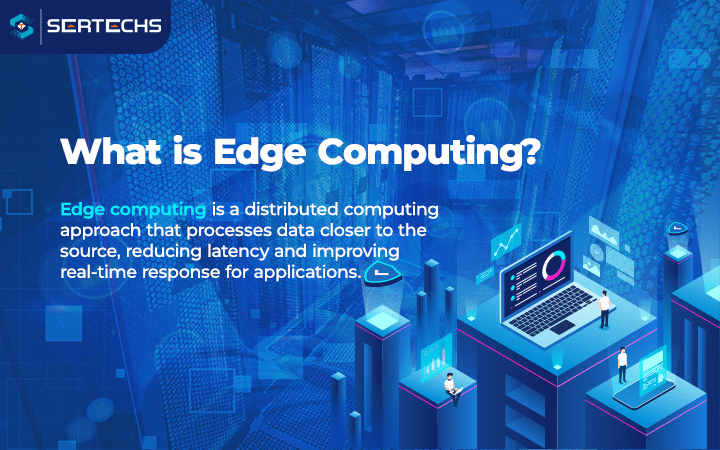
Edge computing refers to a decentralized computing paradigm where data processing and computation are performed closer to the data source or “edge” of a network, rather than relying solely on centralized cloud servers or data centers. The goal of edge computing is to reduce latency, improve real-time processing, and enhance the overall efficiency of data processing and analytics.
Key characteristics and components include:
Proximity to Data Source:
Edge computing devices are typically placed in close proximity to where data is generated, such as IoT (Internet of Things) sensors, mobile devices, or machinery.
Low Latency:
By processing data locally, it reduces the time it takes for data to travel back and forth to a centralized server, leading to lower latency and faster response times for applications that require real-time or near-real-time processing.
Bandwidth Optimization:
It can help optimize network bandwidth usage by filtering and processing data locally before transmitting only relevant or summarized information to the central cloud. This reduces the strain on network infrastructure.
Autonomy:
It can operate autonomously, even when disconnected from the central cloud. They can make decisions and take actions locally, which is critical for applications that need to function in remote or disconnected environments.
Data Security and Privacy:
Some data, especially sensitive or private information, may be processed and stored locally on edge devices to enhance security and privacy, reducing the risk of data breaches.
Scalability:
It can scale horizontally by adding more edge devices as needed, making it suitable for distributed and dynamic environments.
Use Cases:
It is applied in various industries, including manufacturing, healthcare, autonomous vehicles, smart cities, agriculture, and more. Examples include predictive maintenance in industrial settings, real-time health monitoring, and autonomous vehicles making split-second decisions.
Edge computing complements cloud computing rather than replacing it. While cloud computing provides centralized storage, data analytics, and management, edge computing brings computation closer to the data source, allowing for faster and more efficient processing of data at the edge of the network.