
SaaS Agreement

A Software as a Service (SaaS) Agreement is a legal contract that defines the terms and conditions under which a software application or service is provided to users. SaaS agreements are crucial for establishing a clear understanding between the SaaS provider (the company offering the software) and the SaaS customer (the user or organization subscribing to the service). Below are some common elements typically included in a SaaS Agreement: Parties involved: Identify the parties involved, including the SaaS provider and the customer. Scope of services: Clearly define the software or services being provided, including any limitations or restrictions. Access and usage rights: Specify the rights granted to the customer regarding the access, use, and functionality of the software. Service level agreements (SLAs): Outline the expected level of service, including uptime guarantees, support, and maintenance. Subscription terms: Define the subscription period, renewal terms, and any termination conditions. Fees and payment terms: Clearly state the fees associated with the SaaS subscription, including any recurring fees, one-time setup fees, or additional charges for extra features. Intellectual property: Clarify ownership of intellectual property rights, ensuring that the SaaS provider retains ownership of the software. Data protection and security: Address how customer data will be handled, stored, and protected, in compliance with relevant data protection laws. Confidentiality: Include provisions regarding the confidentiality of information exchanged between the parties. Warranties and disclaimers: Specify any warranties provided by the SaaS provider and disclaimers of liability for certain types of damages. Indemnification: Define the responsibilities of each party in case of a breach or legal action, including indemnification clauses. Limitation of liability: Establish the maximum liability of each party in the event of a dispute or loss. Governing law and dispute resolution: Specify the jurisdiction governing the agreement and outline procedures for dispute resolution. Changes and updates: Address how changes or updates to the software will be managed, including notification procedures. Termination clauses: Detail the conditions under which either party can terminate the agreement, along with any associated consequences. It’s important for both parties to thoroughly review and understand the terms of the SaaS Agreement before entering into the contract. Legal advice may be sought to ensure that the agreement meets the specific needs and requirements of both parties.
Software as a Service
Software as a Service (SaaS) is a software distribution model where applications are hosted by a third-party provider and made available to customers over the internet. In this model, users can access the software and its features through a web browser, eliminating the need for users to install, maintain, and update the software on their individual devices. Key characteristics of Software as a Service include: Subscription-based pricing: Instead of purchasing a software license, users typically pay a recurring subscription fee to access the SaaS application. This can be monthly, annually, or based on some other billing cycle. Accessibility: SaaS applications are usually accessible from any device with an internet connection and a web browser. This allows users to access the software from different locations and devices without the need for specific installations. Automatic updates: SaaS providers handle software maintenance, updates, and patches. This ensures that users always have access to the latest features and security updates without having to manually install updates. Scalability: SaaS applications often provide scalable solutions, allowing users to easily adjust their subscription plans based on their changing needs, such as the number of users or the level of service required. Multi-tenancy: SaaS applications are designed to serve multiple customers (tenants) on a shared infrastructure. This allows providers to achieve economies of scale and offer cost-effective solutions to a broad user base. Centralized data: Data generated and used within the SaaS application is typically stored in a centralized data center managed by the service provider. This centralization simplifies data management and backup processes. Collaboration features: Many SaaS applications are designed to facilitate collaboration among users. Features such as real-time editing, file sharing, and communication tools are often integrated into the software. Common examples of SaaS applications include customer relationship management (CRM) tools, enterprise resource planning (ERP) systems, office software suites, project management tools, and communication and collaboration platforms. The SaaS model has gained popularity due to its flexibility, cost-effectiveness, and the ability to streamline software deployment and maintenance for both providers and users.
Software Development Life Cycle (SDLC)
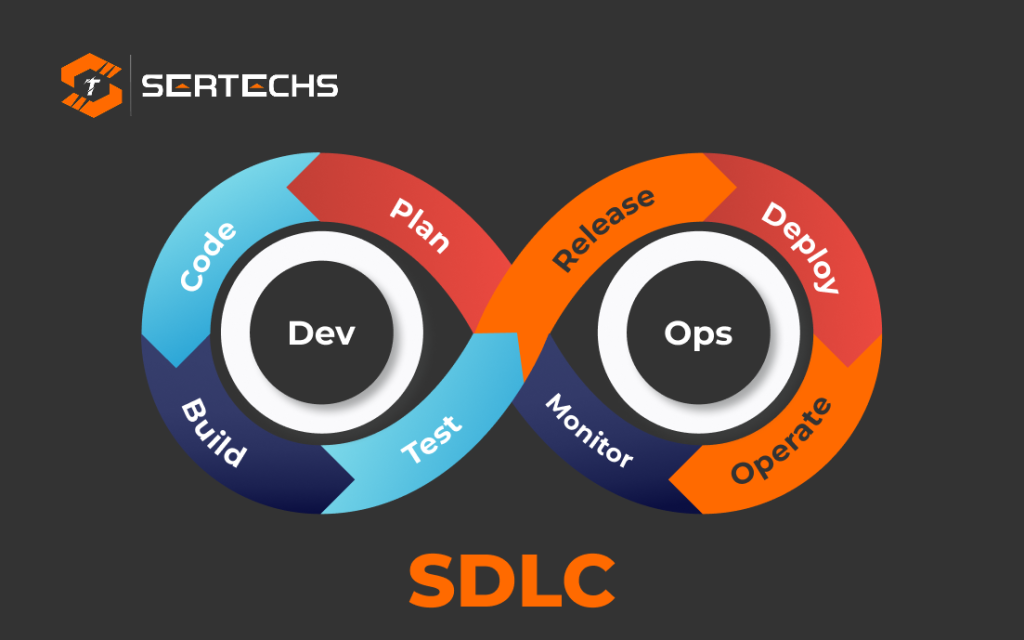
The Software Development Life Cycle (SDLC) is a systematic process for planning, creating, testing, deploying, and maintaining software. It provides a structured framework for developers and project managers to follow, ensuring that the software is developed efficiently and meets the desired quality standards. The SDLC typically consists of several phases, each with its own set of activities, deliverables, and goals. While there are various models, a commonly used one includes the following stages: Requirements Gathering and Analysis: Objective: Understand and document the software requirements. Activities: Gather information from stakeholders, analyze requirements, and create a detailed specification document. Deliverables: Requirements specification document. Planning: Objective: Plan the project, define scope, estimate resources, and create a project schedule. Activities: Develop a project plan, identify tasks, allocate resources, and set timelines. Deliverables: Project plan, resource allocation, and schedule documents. Design: Objective: Create a blueprint for the software based on the requirements. Activities: System architecture design, detailed technical specifications, and user interface design. Deliverables: System architecture diagrams, design documents, and prototypes. Implementation (Coding): Objective: Translate the design into actual code. Activities: Write code according to the design specifications, perform unit testing, and resolve issues. Deliverables: Executable code. Testing: Objective: Verify that the software meets the specified requirements and functions correctly. Activities: Conduct various testing types such as unit testing, integration testing, system testing, and acceptance testing. Deliverables: Test cases, test scripts, and defect reports. Deployment: Objective: Release the software to end-users or clients. Activities: Prepare for deployment, conduct user training, and ensure a smooth transition to production. Deliverables: Deployed software, user manuals, and training materials. Maintenance and Support: Objective: Address issues, update the software, and provide ongoing support. Activities: Fix bugs, implement updates, and provide user support. Deliverables: Updated software versions, maintenance documentation. It’s important to note that the Software Development Life Cycle is not always a linear process, and iterative models like Agile SDLC introduce cycles of planning, development, and testing in shorter iterations. Different organizations may adopt variations of the SDLC based on their specific needs and the nature of the project. The goal is to create a structured and repeatable process that leads to the successful development of high-quality software.
Business Intelligence (BI) and Analytics
Business Intelligence (BI) and Analytics are crucial components of modern business operations, aiding in data-driven decision-making processes. Although often used interchangeably, they encompass different aspects within the realm of data analysis. Business Intelligence (BI): Definition: BI involves the tools, technologies, and strategies used to gather, analyze, and transform raw data into actionable insights for business purposes. Purpose: BI focuses on providing historical, current, and predictive views of business operations. It helps in understanding trends, monitoring performance, and identifying areas for improvement. Characteristics: Reporting and Dashboards: Generates reports and visual dashboards to present data in a structured and understandable format. Data Warehousing: Collects and stores data from various sources into a central repository for analysis. Querying and Analysis: Allows users to perform queries and analyze data to discover patterns and trends. Performance Monitoring: Monitors KPIs and metrics to evaluate business performance. Tools and Technologies: Examples include Tableau, Power BI, QlikView, and SAP BusinessObjects. Analytics: Definition: Analytics involves the exploration of data using statistical analysis, predictive modeling, and machine learning to gain deeper insights and make informed predictions. Purpose: Analytics focuses on examining data to uncover meaningful patterns, correlations, and trends that help in forecasting future outcomes and making proactive decisions. Characteristics: Descriptive Analytics: Summarizes historical data to understand past events and performance. Predictive Analytics: Uses statistical models and machine learning algorithms to forecast future trends and outcomes. Prescriptive Analytics: Suggests actions to optimize future outcomes based on predictive insights. Types: Diagnostic Analytics: Identifies reasons behind certain outcomes by analyzing data. Predictive Analytics: Forecasts future trends and behaviors. Prescriptive Analytics: Recommends actions based on predictions. Relationship between BI and Analytics: BI often serves as a foundational component for analytics. BI tools gather and organize data, which can then be used in advanced analytics to derive deeper insights and predictive models. Analytics leverages the data processed by BI to perform in-depth analysis, predictive modeling, and advanced statistical operations, providing a more comprehensive understanding of business trends and potential future scenarios. Both Business Intelligence (BI) and Analytics play crucial roles in harnessing the power of data to support decision-making, optimize processes, and gain a competitive advantage in today’s business landscape.
Chatbots and conversational interfaces
Chatbots and conversational interfaces are artificial intelligence (AI)-powered systems designed to simulate human conversation or interaction. They are used across various platforms, including websites, messaging apps, social media, and customer service portals, to engage users in natural language conversations. These interfaces rely on Natural Language Processing (NLP) and machine learning algorithms to understand user queries, interpret the context, and generate appropriate responses. They can handle a wide range of tasks, from answering FAQs and providing information to executing specific actions, making reservations, or assisting with troubleshooting. Key components of chatbots and conversational interfaces include: NLP (Natural Language Processing): This technology allows machines to understand, interpret, and generate human language. It involves tasks like sentiment analysis, entity recognition, language translation, and intent recognition. Machine Learning: Chatbots learn from data and user interactions, improving their accuracy and performance over time. They use machine learning algorithms to adapt to new information and user behavior. User Input Processing: Conversational interfaces analyze user input to determine intent, context, and required actions. This involves breaking down the user’s query, identifying keywords, and understanding the user’s intent to provide relevant responses. Response Generation: Once the user’s intent is understood, the chatbot generates an appropriate response. This can range from providing information, suggesting options, executing commands, or initiating actions. Integration with Backend Systems: Chatbots often integrate with various backend systems, databases, or APIs to fetch relevant information or perform specific tasks like retrieving account information, processing payments, or accessing inventory data. Dialog Management: It involves maintaining context throughout a conversation, remembering previous interactions, and ensuring coherence in the conversation flow. Types of chatbots and conversational interfaces include: Rule-Based Chatbots: Follow predefined rules and decision trees. They provide responses based on specific keywords or patterns. AI-Powered Chatbots: Utilize machine learning and NLP to understand and respond to user queries, adapting and learning from interactions. Voice Assistants: Such as Siri, Alexa, and Google Assistant, offer spoken interaction capabilities, enabling users to interact through speech. Messaging Chatbots: Deployed within messaging apps (e.g., Facebook Messenger, WhatsApp) to facilitate conversations, provide information, or assist with tasks. Chatbots and conversational interfaces continue to evolve, becoming more sophisticated and capable of handling complex tasks. Businesses adopt them to improve customer service, streamline processes, enhance user experience, and increase operational efficiency.
IT Offshoring
Offshoring in IT refers to the practice of a company hiring a third-party service provider or setting up its operations in a different country to perform IT-related tasks, services, or development work. This practice is primarily done to leverage cost advantages, access a larger talent pool, or benefit from different time zones. Here are some key aspects of IT offshoring: Cost Efficiency: Offshoring IT services to countries with lower labor costs can significantly reduce operational expenses for companies, as labor, infrastructure, and other overheads may be cheaper abroad. Access to Global Talent: It enables access to a broader talent pool. Companies can tap into skilled professionals in different parts of the world. That allowing them to find specialized expertise that might not be available locally. Round-the-Clock Operations: Time zone differences can be advantageous, allowing companies to operate continuously. They having teams in different parts of the world working on the same projects in different shifts. Scalability and Flexibility: Offshoring offers scalability options, allowing companies to quickly scale up or down their operations based on project requirements without the need for significant infrastructure changes. Challenges: It also presents challenges such as language barriers, cultural differences, communication issues, data security concerns. The need for effective management across geographically dispersed teams. Access to Skilled Talent: Offshoring allows access to a diverse and often larger pool of skilled professionals. This includes technical experts, programmers, developers, engineers, and other IT specialists who may possess niche skills that are in high demand. Types of Offshoring: It can take various forms, including captive offshoring (subsidiary in another country), outsourcing (third-party vendor), or a
jQuery
jQuery is a fast, small, and feature-rich JavaScript library. It simplifies client-side scripting in HTML and is designed to make things like HTML document traversal and manipulation, event handling, and animation much simpler with an easy-to-use API that works across different browsers. Key features include: DOM Manipulation: jQuery simplifies interacting with the Document Object Model (DOM), allowing developers to easily select elements, modify their content, style, or attributes. Event Handling: It provides methods to handle various events on elements, such as click, hover, submit, etc., making event binding straightforward. AJAX Support: jQuery simplifies the process of making AJAX requests, allowing developers to fetch data from a server without having to reload the entire page. Animations: It offers built-in animation effects and methods to create dynamic and interactive user interfaces. Cross-Browser Compatibility: It handles many cross-browser issues and inconsistencies, providing a consistent interface across different browsers. Plugins: jQuery has a vast ecosystem of plugins that extend its functionality, allowing developers to add complex features easily. Benefits of Using jQuery: Simplicity and Ease of Use: jQuery’s syntax is concise and easy to learn, making it accessible for developers, especially beginners. Enhanced Productivity: It simplifies common tasks, reduces the amount of code needed, and speeds up development time. Wide Adoption and Community Support: It has been widely adopted, leading to a large community of developers who contribute plugins, tutorials, and support. With the evolution of modern web standards, the need for jQuery has diminished in certain cases. Many functionalities provided by jQuery are now available through native browser APIs or modern JavaScript frameworks, which are optimized for performance and maintainability. jQuery gained immense popularity due to its ease of use, extensive documentation, and wide range of functionalities. However, with advancements in modern JavaScript and improvements in browser APIs, many features that they provided have become native functionalities in modern browsers. Still, it remains in use in legacy systems and for scenarios where its simplicity and concise syntax are preferred.
JavaScript Frameworks
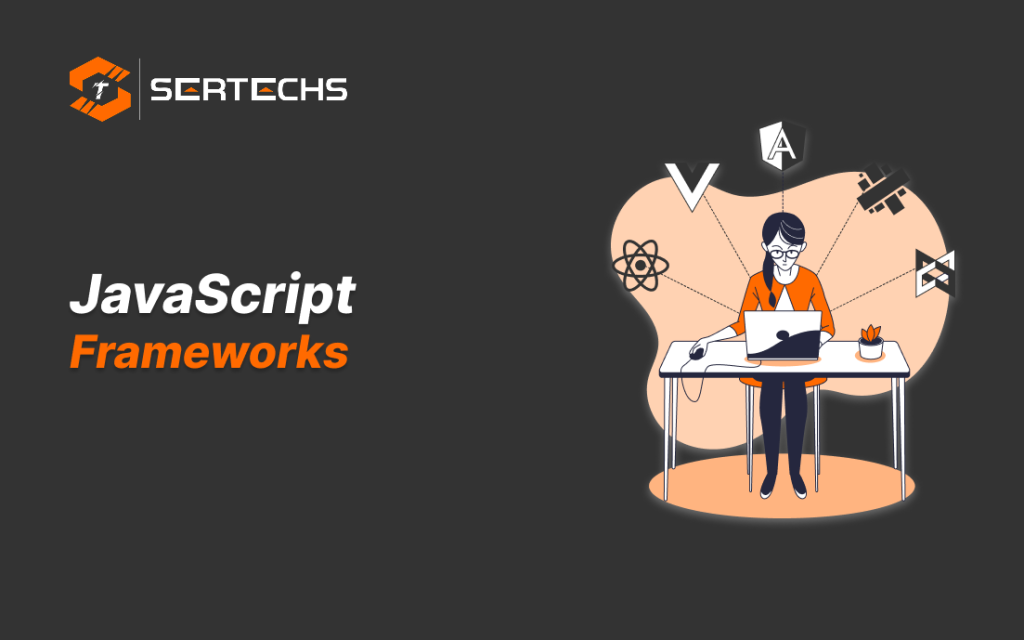
JavaScript frameworks are pre-written, standardized sets of code that help developers build web applications efficiently. They provide a structure for developers to create robust, scalable, and maintainable web applications by offering tools, libraries, and reusable components. It supports various data types such as numbers, strings, booleans, objects, arrays, functions, and more. It’s loosely typed, allowing variables to hold different types of data. Here are some popular JavaScript frameworks: React: Developed by Facebook, React is a widely used library for building user interfaces. It employs a component-based architecture and allows developers to create reusable UI components. Angular: Created and maintained by Google, Angular is a comprehensive framework for building web applications. It follows the MVC (Model-View-Controller) architecture and offers features like two-way data binding. Vue.js: Vue.js is a progressive JavaScript framework that is lightweight and easy to integrate. It focuses on the view layer and provides a flexible and approachable structure for building UIs. Node.js: Although not a traditional front-end framework, Node.js is a runtime environment that enables developers to run JavaScript code on the server-side. It’s commonly used for building scalable network applications. Ember.js: Ember.js is an opinionated framework that emphasizes convention over configuration. It provides a set of tools and practices to streamline the development process. Svelte: Unlike other frameworks, Svelte shifts the work from the browser to the build step. It compiles the code to highly efficient JavaScript during the build process, resulting in smaller bundle sizes and optimized performance. Backbone.js: This is a lightweight framework that provides the structure for building single-page applications by providing models, views, collections, and event handling. These frameworks and libraries have their strengths and weaknesses, and their suitability often depends on the specific requirements of a project, the development team’s familiarity, scalability needs, and the type of application being built. Developers often choose frameworks based on factors such as ease of learning, community support, performance, scalability, and flexibility.
JavaScript
JavaScript is a versatile programming language primarily used for creating dynamic content on webpages. Developed by Netscape as “LiveScript” in the mid-1990s, it was later renamed JavaScript. Despite the similar name, JavaScript has no direct relation to the Java programming language; they are different languages with distinct syntax and purposes. Here are some key aspects of JS: Client-Side Scripting: JavaScript is primarily employed as a client-side scripting language, running in a user’s web browser. It allows web developers to create interactive and dynamic elements within web pages. High-Level, Interpreted Language: JS is a high-level language, meaning its syntax is closer to human language and is relatively easy to read and write. It’s also an interpreted language, executed line-by-line without needing a compilation step. Event-Driven and Asynchronous: It is event-driven, meaning it responds to events such as user actions (clicks, inputs, etc.) or system-generated events. It’s asynchronous, allowing for non-blocking execution, crucial for handling tasks like fetching data from servers without stopping other operations. Used in Web Development: JavaScript is a fundamental part of modern web development. It is used to manipulate and modify HTML and CSS, create animations, handle user interactions, build web applications (including single-page applications), and much more. Supports Various Paradigms: It supports multiple programming paradigms, including procedural, object-oriented, and functional programming styles. This flexibility allows developers to choose the approach that best fits their project. Extensive Ecosystem: JS has a vast ecosystem with numerous libraries and frameworks like React, Angular, Vue.js, and Node.js, which extend its capabilities for various purposes, including front-end and back-end development. Cross-platform Language: It isn’t limited to web browsers anymore. With the help of runtimes like Node.js, developers can use JavaScript for server-side scripting, enabling them to build full-stack applications entirely in JavaScript. JavaScript is a fundamental technology for web development, playing a crucial role in creating modern, interactive, and responsive web applications. Its continual evolution and widespread adoption have made it an essential skill for developers.
PHP Frameworks
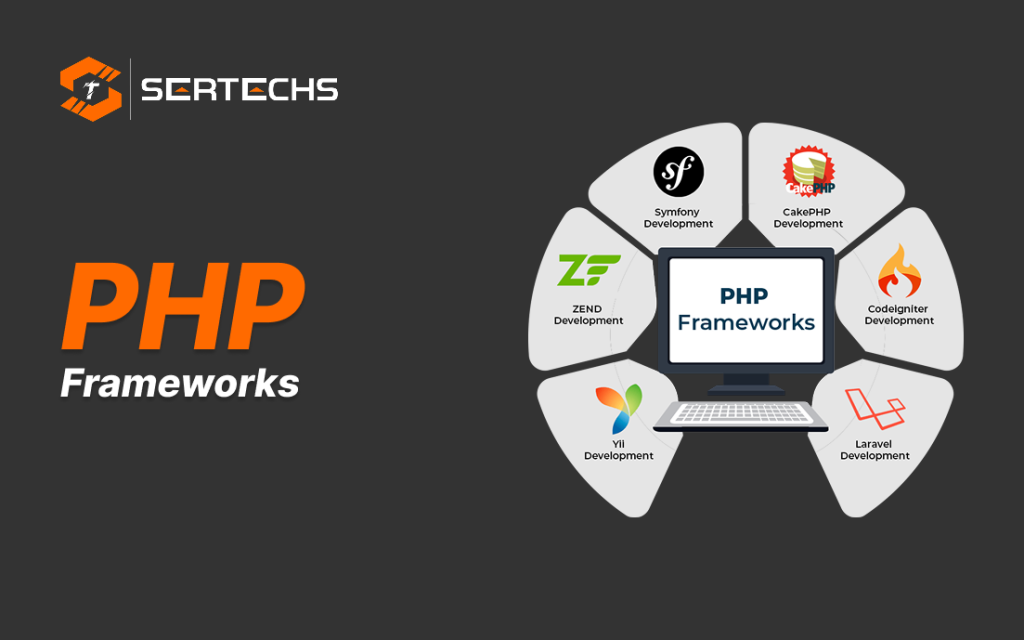
In PHP, a framework refers to a pre-built structure that provides a foundation for developing web applications. Frameworks in PHP offer a set of tools, libraries, and reusable components to facilitate the development process, allowing developers to build applications more efficiently by following predefined patterns and best practices. Some popular PHP frameworks include: Laravel: Known for its elegant syntax and expressive features, Laravel is one of the most widely used PHP frameworks. PHP frameworks are essential tools for web developers that provide a structured foundation for building web applications. It offers a robust set of tools for building web applications, including routing, authentication, database ORM (Object-Relational Mapping), and more. Symfony: This framework provides a set of reusable PHP components and libraries. It’s highly customizable and suitable for creating both small-scale and large-scale applications. CodeIgniter: Known for its simplicity and small footprint, CodeIgniter is lightweight and straightforward to use. It’s suitable for developers who prefer a simpler structure and need to build applications quickly. Yii: Yii is a high-performance PHP framework known for its speed and security features. It follows the DRY (Don’t Repeat Yourself) principle and offers features like scaffolding, caching, and authentication. CakePHP: CakePHP is a robust framework that follows the convention-over-configuration principle. It simplifies the development process by reducing the need for configuration, enabling developers to focus more on the application logic. Zend Framework (Laminas Project): Now known as the Laminas Project after rebranding, it’s a collection of professional PHP packages suitable for enterprise-level applications. It offers a high degree of flexibility and follows modern PHP development practices. These frameworks provide various features like routing, database abstraction, templating engines, security mechanisms, and more, helping developers to build secure, scalable, and maintainable web applications. The choice of framework often depends on project requirements, developer familiarity, scalability needs, and the specific features offered by each framework.