
Humanoid Robots

Humanoid robots are robots designed to resemble and mimic the physical characteristics and movements of humans. These robots are typically equipped with a human-like body structure, including two arms, two legs, and a head. Humanoid robots are developed for various purposes, including research, entertainment, education, and assistance in tasks that require human-like dexterity and mobility. Here are some key aspects and applications of humanoid robots: Research and Development: Humanoid robots are used in research to study human locomotion, perception, and cognition. They help researchers better understand human anatomy and behavior, enabling advancements in fields like biomechanics, neuroscience, and psychology. Education and Training: It can serve as educational tools for teaching robotics and programming. They are often used in schools and universities to help students learn about robotics concepts and develop their programming skills. Entertainment: They are used in the entertainment industry, particularly in theme parks, museums, and exhibitions. They can interact with visitors, perform dances, and provide a novel and engaging experience for entertainment purposes. Healthcare and Rehabilitation: Some robots are designed to assist in healthcare and rehabilitation. They can help patients with mobility and therapeutic exercises. For example, the robotic exoskeleton HAL (Hybrid Assistive Limb) is used to assist individuals with mobility impairments. Elderly Care: Humanoid robots are being explored as potential caregivers for the elderly. These robots can provide companionship, monitor vital signs, and assist with daily tasks to support the aging population. Search and Rescue: In disaster-stricken areas, humanoid robots can be deployed for search and rescue missions. Their ability to navigate complex environments and perform tasks such as opening doors and moving debris can be crucial in saving lives. Manufacturing and Industry: They are used in industrial settings to perform tasks that require fine motor skills and dexterity. They can be employed for tasks like quality control, product assembly, and machine operation. Space Exploration: NASA and other space agencies have developed humanoid robots, such as Robonaut, to assist astronauts in space missions. These robots can perform maintenance and repair tasks in the challenging environment of space. Social Interaction and Communication: Its like Pepper and Sophia are designed to interact with people in a socially engaging manner. They can understand and respond to human speech, make eye contact, and express emotions through facial expressions. Future Applications: As technology advances, the potential applications for humanoid robots continue to expand. These robots are being developed with more sophisticated sensors, artificial intelligence, and advanced mechanical designs to enhance their capabilities and broaden their use cases. Challenges in developing humanoid robots include the complexity of replicating human movement and dexterity, power supply limitations, and the need for advanced AI for natural interaction with humans. Despite these challenges, ongoing research and development in the field of robotics are pushing the boundaries of what humanoid robots can achieve.
Scope of AI
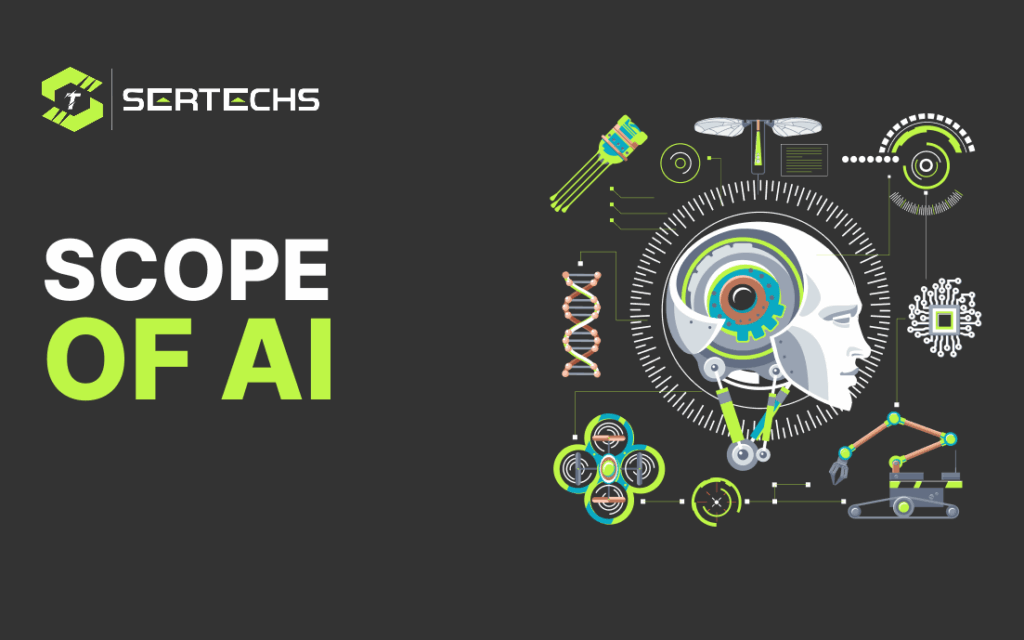
The scope of AI is vast and continually expanding, making it a dynamic and exciting field with a broad range of applications and opportunities. Here are some key aspects of the scope of AI: Industry Applications: AI is being applied across various industries, including healthcare, finance, manufacturing, retail, agriculture, and transportation. It’s used for predictive analytics, process optimization, automation, and decision support. Healthcare: AI is used for medical diagnosis, drug discovery, personalized medicine, patient monitoring, and administrative tasks. It can help improve patient outcomes, reduce healthcare costs, and streamline healthcare operations. Autonomous Systems: Self-driving cars, drones, and robotics are some of the autonomous systems powered by AI. They have the potential to revolutionize transportation, logistics, and various industries. Natural Language Processing (NLP): NLP technologies enable machines to understand, generate, and interact with human language. Applications include chatbots, language translation, sentiment analysis, and content generation. Computer Vision: AI is used for image and video analysis, enabling applications like facial recognition, object detection, autonomous surveillance, and augmented reality. Recommendation Systems: AI-driven recommendation engines are common in e-commerce, content streaming, and social media platforms. They help businesses personalize user experiences and boost engagement. Financial Services: AI is used for algorithmic trading, fraud detection, credit risk assessment, and customer service in the financial sector. It can enhance decision-making and risk management. Cybersecurity: AI is employed to detect and mitigate cybersecurity threats, including identifying anomalies and potential breaches in real-time. Education: AI can provide personalized learning experiences, automate administrative tasks, and assist in grading and assessment. Environmental and Sustainability Applications: AI is used for climate modeling, energy optimization, and monitoring wildlife and ecosystems, contributing to environmental conservation. Entertainment and Gaming: AI enhances gaming experiences with intelligent non-player characters, realistic physics simulations, and procedural content generation. Humanoid Robots: Advances in robotics and AI are leading to more human-like robots with applications in healthcare, customer service, and companionship. Space Exploration: AI plays a crucial role in autonomous spacecraft navigation, data analysis, and robotics for planetary exploration. AI Ethics and Regulation: The growing use of AI has led to increased focus on AI ethics, transparency, and regulations to ensure responsible AI development and deployment. Research and Development: AI researchers are continually pushing the boundaries of the field, developing new algorithms, and addressing complex challenges. The scope of AI is broad, and it offers significant career opportunities for professionals in various domains, including AI research, software development, data science, and AI ethics. As AI technologies continue to advance, they are likely to become more integrated into our daily lives, revolutionizing how we work, live, and interact with technology. However, addressing ethical and societal considerations will also be a crucial part of AI’s future scope.
Information technology management

Information technology management (IT management) involves planning, organizing, and overseeing the implementation and maintenance of an organization’s technology infrastructure and resources to achieve its goals and objectives. It encompasses various aspects, including technology strategy, project management, resource allocation, security, and compliance. key components and concepts of Information technology management: IT Strategy and Planning: Developing a strategic roadmap aligning technology with organizational goals. Assessing current IT capabilities and identifying areas for improvement. Project Management: Planning, executing, and controlling IT projects to deliver desired outcomes on time and within budget. Utilizing methodologies like Agile, Waterfall, or Hybrid for project execution. Resource Management: Efficiently managing IT resources, including human resources, budgets, and infrastructure. Optimizing resource allocation to ensure optimal performance and cost-effectiveness. IT Infrastructure and Operations: Managing and maintaining hardware, software, networks, and other technological components. Ensuring high availability, reliability, and performance of IT services. Cybersecurity and Compliance: Implementing measures to safeguard data, systems, and networks from cyber threats. Adhering to legal and regulatory requirements related to data protection and privacy. Service Management: Implementing IT service management (ITSM) frameworks like ITIL to enhance service quality and customer satisfaction. Focusing on incident management, problem resolution, change management, and service level agreements (SLAs). Vendor and Supplier Management: Managing relationships with technology vendors and suppliers to ensure effective procurement and contract management. Evaluating and selecting vendors based on performance, cost, and alignment with organizational needs. Business Continuity and Disaster Recovery: Planning for contingencies to ensure business operations can continue in the event of a disaster or disruptive event. Establishing backup and recovery strategies to minimize data loss and downtime. Innovation and Emerging Technologies: Monitoring and evaluating emerging technologies to identify opportunities for innovation and competitive advantage. Incorporating new technologies, such as artificial intelligence, cloud computing, and IoT, into the organization’s strategy. Change Management: Managing organizational change associated with new IT implementations or modifications to existing systems. Communicating changes effectively and ensuring employee readiness and adoption. Performance Measurement and KPIs: Defining key performance indicators (KPIs) to measure the effectiveness and efficiency of IT initiatives. Analyzing data to make informed decisions and continuously improve IT processes. Effective IT management involves aligning technology with business objectives, ensuring security and compliance, optimizing resource utilization, fostering innovation, and adapting to changes in the technology landscape. It’s a crucial function for organizations seeking to leverage technology for competitive advantage and operational efficiency.
How information technology works
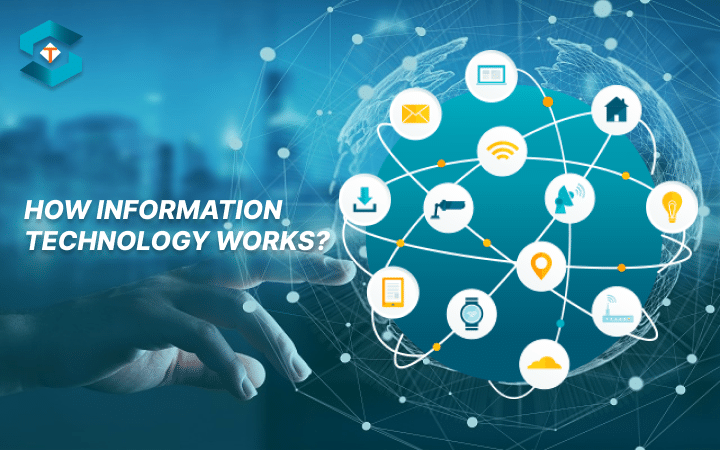
Information Technology (IT) is a vast and multifaceted field that encompasses a wide range of technologies and processes used to manage and manipulate data, communicate information. Understanding how information technology works involves grasping the principles and mechanisms behind digital data processing and communication systems. Here’s a simplified overview of how Information Technology works: Data Generation and Input: IT begins with the generation or collection of data. Data can be created by users, sensors, devices, or other sources. It can include text, numbers, images, videos, and more. Data Storage: Once data is generated, it needs to be stored for future use. Information technology employs various storage technologies, such as hard drives, databases, and cloud storage, and organize data. Data Processing: To make data useful, it often requires processing. This involves performing calculations, transformations, and analyses on the data. Computers and servers equipped with processors and memory are used for data processing tasks. Data Transmission and Networking: Technology enables the transmission of data from one location to another. Networking technologies like routers, switches, and cables are used to establish connections and transfer data between devices, both locally and over the internet. Software and Applications: Software applications or programs are used to perform specific tasks and operations on the data. Operating systems, applications, and middleware facilitate the functioning of hardware and provide a platform for software applications to run. Information Security: Protecting data from unauthorized access and threats is a critical aspect of Information technology. Security measures, such as firewalls, access controls, and antivirus software, are used to safeguard data and systems. Cloud Computing: Cloud computing allows the use of computing resources (e.g., storage, processing power) over the internet. Virtualization enables the creation of virtual instances of hardware or software, optimizing resource utilization. Data Retrieval and Output: Once data is processed or stored, it can be retrieved and presented to users in a meaningful way. This includes displaying text on a screen, generating charts. Problem Solving and Troubleshooting: IT professionals are responsible for identifying and resolving technical issues and challenges that arise in hardware, software, and network systems. Hardware Components: It relies on various hardware components such as computers, servers, routers, and storage devices. These components work together to process and transmit data. Data Analytics and Business Intelligence: Information technology enables organizations to gain insights from data through analytics and business intelligence tools, helping in decision-making. User Interface and Interaction: Users interact with IT systems through interfaces such as graphical user interfaces (GUIs), command-line interfaces (CLIs), or voice commands. These interfaces allow users to interact with software applications and access information. How Information technology works, It is a multidisciplinary field that involves hardware, software, and problem-solving to enable the efficient use of information and technology. The specific workings of Information technology can vary greatly depending on the context and the technology being employed.
Why IT Jobs Are in High Demand

IT (Information Technology) jobs are in high demand due to several factors. That reflect the evolving technological landscape and its increasing influence on various aspects of modern life and business. Here are key reasons why IT jobs are in high demand: Digital Transformation: Organizations across industries are embracing digital transformation to stay competitive and relevant. This transformation requires IT professionals to develop, implement, and manage digital technologies and processes. Growing Dependence on Technology: Businesses and individuals rely heavily on technology for communication, transactions, education, healthcare, and more. This dependence increases the demand for IT professionals who can ensure the smooth functioning and security of these technologies. Rapid Technological Advancements: The fast pace of technological advancements, such as artificial intelligence (AI), blockchain, 5G, and the Internet of Things (IoT), drives the need for skilled IT professionals to design, develop, and manage these technologies. Data Explosion and Big Data Analytics: The exponential growth of data generated daily requires professionals with expertise in managing and analyzing large volumes of data. Big data analytics is crucial for deriving valuable insights and making informed business decisions. Remote Work and Digital Collaboration: The need for seamless digital collaboration tools have increased the demand for IT professionals who can design, implement, and support remote work infrastructures and applications. Healthcare and Telemedicine: The integration of technology in healthcare, including electronic health records (EHR), telemedicine, and health monitoring devices, requires IT experts to develop and manage these solutions for improved patient care. Data Privacy and Compliance: The increasing focus on data privacy laws and regulations, such as GDPR and CCPA, demands IT professionals to ensure compliance and data protection within organizations. Education Technology (EdTech): The growth of online education and e-learning platforms requires IT professionals to develop educational technologies, learning management systems (LMS), and online courses. The continuous evolution of technology into various industries ensures a sustained high demand for skilled IT professionals with expertise in emerging technologies and the ability to adapt to evolving trends. As a result, IT remains a promising and sought-after career field.
Regulatory Technology
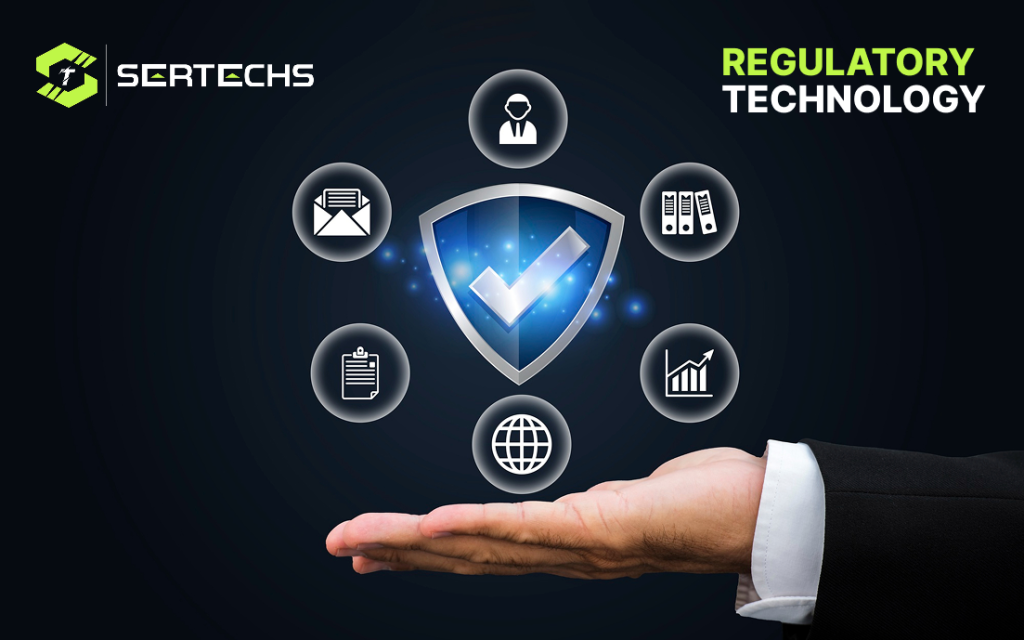
RegTech, short for Regulatory Technology , refers to the use of technology to help businesses and financial institutions comply with regulatory requirements more efficiently and cost-effectively. It leverages advancements in technologies like artificial intelligence (AI), big data, blockchain, and machine learning to address the growing burden of compliance in various industries, especially finance and banking. RegTech solutions leverage advanced technologies, data analytics, and automation to streamline compliance processes, improve reporting accuracy, and ensure adherence to regulatory requirements within various industries. Key aspects of Regulatory Technology include: Compliance and Regulatory Reporting: RegTech solutions automate and streamline compliance processes , making it easier for organizations to adhere to industry-specific regulations and reporting requirements. Risk Management: RegTech helps in assessing, managing, and mitigating risks associated with regulatory compliance. It offers tools for risk monitoring, real-time reporting, and predictive analytics. Data Management and Analytics: RegTech solutions process and analyze vast amounts of data to ensure compliance with regulatory standards. They help in identifying trends, anomalies, and potential compliance violations. Identity Verification and Authentication: RegTech provides advanced solutions for customer identity verification and authentication, ensuring compliance with Know Your Customer (KYC) and Anti-Money Laundering (AML) regulations. Reporting and Audit Trails: RegTech solutions facilitate the creation of detailed audit trails and comprehensive reports, which are crucial for regulatory audits and compliance assessments. Integration with Existing Systems: RegTech solutions are designed to seamlessly integrate with existing enterprise systems, making adoption and implementation smoother for organizations. Regulatory Sandbox Environments: Some regulatory authorities provide regulatory sandboxes, allowing companies to test and deploy innovative RegTech solutions in a controlled environment before full-scale implementation. RegTech plays a critical role in the financial sector , helping institutions comply with the constantly evolving regulatory landscape. It enables organizations to reduce compliance costs, enhance risk management practices, and improve the overall efficiency and effectiveness of compliance efforts.
Enhanced Communication
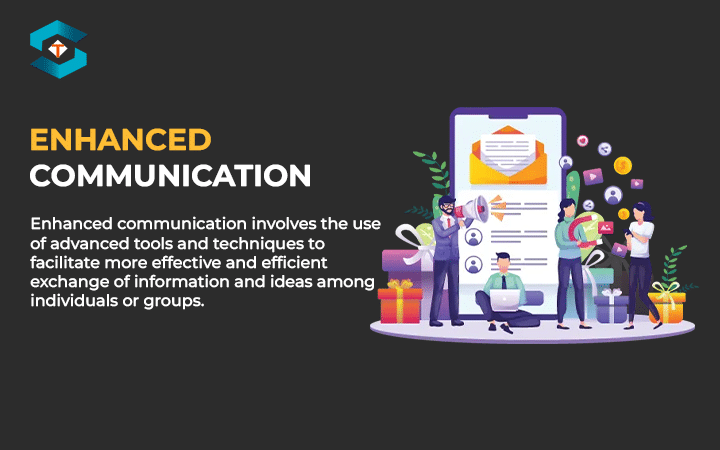
Enhanced Communication refers to the improved and advanced methods and technologies that facilitate effective and efficient exchange of information, ideas, and messages between individuals or entities. It encompasses various tools, techniques, and platforms designed to enhance the quality, speed, reach, and accessibility of communication. In various contexts, whether personal, professional, or technological, enhancing communication is crucial for better understanding, collaboration, and decision-making. Here are some aspects of enhanced communication: Real-Time Communication: Technologies such as instant messaging, video conferencing, and voice over IP (VoIP) enable real-time communication, allowing people to connect and interact instantly regardless of their locations. Video Conferencing and Virtual Meetings: Video conferencing platforms facilitate face-to-face communication over the internet, allowing individuals and teams to hold meetings and share information. Unified Communication Systems: Integrated platforms that bring together various communication channels like email, calls, messaging, and collaboration tools into a unified interface, streamlining communication and enhancing productivity. Mobile Communication: Mobile devices and applications enable communication on the go, providing the flexibility to send messages, make calls, and access information from anywhere, at any time. Social Media and Networking: Social media platforms facilitate communication and networking on a global scale, allowing individuals and organizations to connect and engage with a broader audience. Voice Assistants and AI Communication: Voice-activated assistants (e.g. Siri, Alexa, Google Assistant) and AI-powered chatbots enhance communication by providing voice-based or text-based interactions and assistance. Data Visualization for Communication: Techniques and tools to present data and complex information visually, aiding in conveying messages more effectively and improving audience understanding. IoT and Communication: Integration of Internet of Things (IoT) devices with communication technologies, enabling devices to communicate and share data for various applications. Enhanced communication plays a pivotal role in personal, professional, and societal interactions, improving collaboration, decision-making. It’s essential to adapt and leverage these advancements to facilitate clear, timely, and meaningful communication.
Virtualization
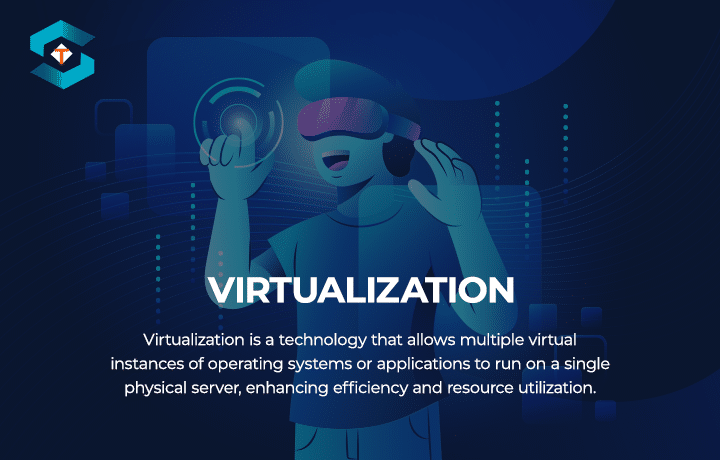
Virtualization is a technology that allows multiple operating systems and applications to run on a single physical server or hardware platform. It involves creating a virtual representation (virtual machine or VM) of the computing resources (such as CPU, memory, storage, and network) to efficiently utilize and manage the underlying hardware. Each virtual machine operates independently, as if it were running on a dedicated physical machine. Key aspects and components of virtualization include: Hypervisor: The hypervisor is a crucial component in virtualization that creates and manages virtual machines. It sits between the hardware and the operating systems and allocates resources to each virtual machine. Virtual Machine (VM): A virtual machine is a software emulation of a physical computer, running an operating system and applications. Multiple VMs can run simultaneously on a single physical server. Host Machine: The physical hardware (server or computer) on which the hypervisor runs and manages the virtual machines. Guest Operating Systems: The operating systems and applications running within each virtual machine. These can be different from the host operating system and from each other. Resource Allocation and Management: Virtualization allows for flexible allocation and management of resources such as CPU, memory, storage, and network. Resources can be dynamically adjusted based on the workload or needs of each virtual machine. Isolation and Encapsulation: Each virtual machine is isolated from others, providing security and stability. VMs are encapsulated into files, making it easy to move, copy, or migrate them to other hardware or cloud environments. Types of Virtualization: Server Virtualization: The most common type, where multiple virtual machines run on a single physical server. Desktop Virtualization: Running multiple virtual desktops on a centralized server, providing a virtualized desktop environment to end-users. Network Virtualization: Abstracting network resources to create a virtual network, allowing for better network management and optimization. Storage Virtualization: Pooling physical storage from multiple network storage devices into a single virtual storage unit for efficient management and utilization. Virtualization has become a foundational technology in modern IT infrastructures, enabling efficient resource usage, cost savings, and improved flexibility in managing and deploying applications and services.
5G Technology
5G Technology, which stands for the fifth generation of mobile networking, is the latest standard for wireless communication. It succeeds 4G (LTE/WiMAX) and offers significantly faster data download and upload speeds, reduced latency, and improved connectivity. Key Features and Advantages of 5G Technology: Enhanced Data Speeds: 5G offers substantially higher data speeds compared to 4G. It can deliver download speeds of several gigabits per second (Gbps), enabling faster streaming, downloading, and uploading of content. Ultra-Low Latency: 5G technology significantly reduces latency (the time it takes for data to travel from sender to receiver). This is critical for applications like real-time gaming, augmented reality (AR), virtual reality (VR), and autonomous vehicles. Massive Device Connectivity: 5G can support a much larger number of devices per square kilometer compared to 4G, making it suitable for densely populated areas and IoT deployments. High Reliability and Availability: 5G is designed to provide high reliability and availability, ensuring consistent and stable connectivity even in challenging environments. Network Slicing: 5G supports network slicing, allowing the network to be divided into multiple virtual networks with different characteristics and capabilities, tailored to specific use cases. Enhanced Security: 5G incorporates improved security features to safeguard against cyber threats and ensure the privacy and integrity of data transmitted over the network. Use Cases and Applications: Mobile Broadband: Faster speeds and lower latency improve the mobile internet experience, enabling smoother streaming, gaming, and browsing on mobile devices. Internet of Things (IoT): 5G’s ability to connect a vast number of devices simultaneously is essential for IoT applications across various industries, including smart cities, healthcare, agriculture, and industrial automation. Autonomous Vehicles: 5G’s low latency and high reliability are critical for enabling communication between autonomous vehicles and supporting real-time decision-making for safe navigation. Virtual and Augmented Reality: 5G enhances the experience of AR and VR applications by reducing latency and providing higher data speeds for seamless content delivery. Smart Infrastructure and Utilities: 5G facilitates smart grid management, remote monitoring of infrastructure, and efficient resource utilization in utilities. Deployment and Infrastructure: Implementing 5G requires significant infrastructure upgrades, including the installation of new base stations, small cells, and improved fiber-optic networks to support the increased data traffic and connectivity demands. Various telecommunication companies and network operators around the world are investing in 5G infrastructure to deploy and expand 5G networks.
Natural Language Processing
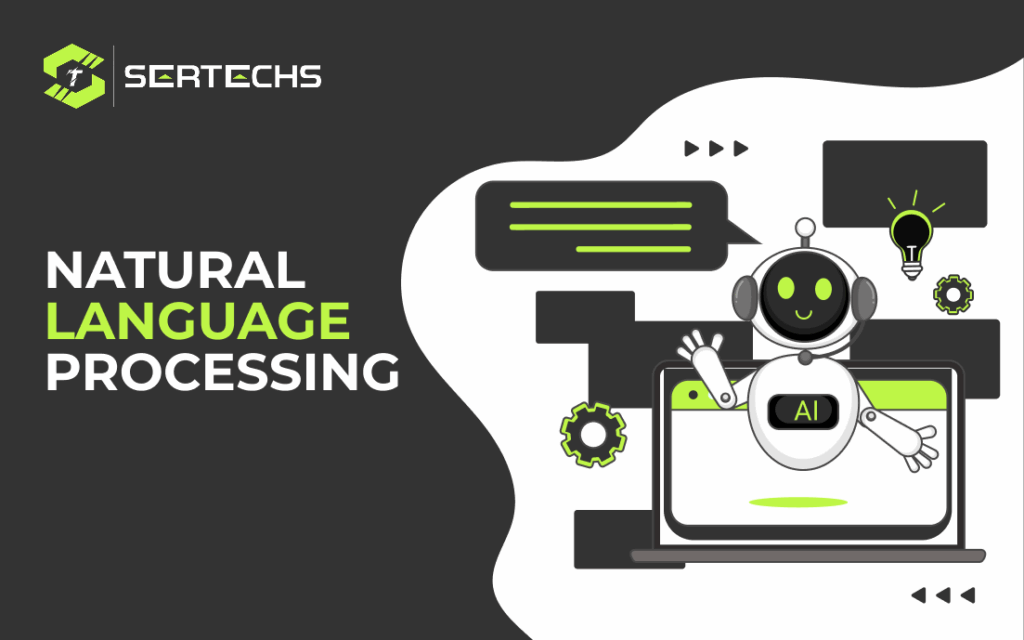
Natural Language Processing (NLP) is a field of artificial intelligence and computer science that focuses on enabling computers to understand, interpret, and generate human language in a valuable and meaningful way. It involves the interaction between computers and natural language, allowing machines to analyze, process, and generate text, speech, and other forms of communication. Key aspects of NLP include: Language Understanding: NLP technologies enable machines to comprehend and interpret human language, including syntax, semantics, context, and sentiment. Text Analysis: NLP algorithms can analyze written text, extracting entities, relationships, sentiment, and other valuable information. Speech Recognition: NLP facilitates the conversion of spoken language into written text, enabling applications like voice assistants and transcription services. Machine Translation: NLP powers translation services that can convert text from one language to another, facilitating cross-language communication. Sentiment Analysis: NLP techniques determine the sentiment or emotion expressed in a piece of text, providing insights into public opinion and customer feedback. Information Retrieval: NLP helps in retrieving relevant information from large volumes of text, making search engines more efficient and effective. Language Generation: Creating human-like text or narratives using algorithms, often seen in content generation, creative writing, and story generation. Language Generation: NLP models can generate human-like text, such as articles, stories, or dialogue, based on given prompts or patterns. Chatbots and Conversational Agents: NLP powers chatbots and virtual assistants, enabling human-like interaction and engagement through text or speech. Understanding Context and Ambiguity: NLP technologies help machines understand context and resolve ambiguous language constructs, improving accuracy in understanding meaning. Language Modeling and Generation: NLP models, such as GPT (Generative Pre-trained Transformer), generate human-like text by learning patterns and structures from vast amounts of data. Natural Language Processing continues to advance, driven by research breakthroughs, larger and more diverse datasets, and improved machine learning algorithms. Its applications are increasingly prevalent in our daily lives, enhancing communication, decision-making, and automation across diverse sectors.