
Serverless Architecture
Serverless architecture, often referred to as serverless computing, is a cloud computing model that abstracts the underlying infrastructure management from developers, allowing them to focus solely on writing and deploying code. In a serverless architecture, the cloud provider takes care of server provisioning, scaling, and resource allocation, relieving developers of many operational concerns. Key features of serverless architecture include: Event-Driven: Serverless functions, also known as “serverless compute,” are triggered by specific events or requests. These events can be HTTP requests, database changes, file uploads, or custom events generated by other parts of the application. Pay-as-You-Go Billing: With serverless, you only pay for the computing resources used during the execution of your functions. This billing model is often referred to as Function as a Service (FaaS). You are not charged for idle resources, which can be cost-effective for applications with variable workloads. Automatic Scaling: Cloud providers automatically handle the scaling of serverless functions. As more events or requests come in, additional instances of the function are spun up to handle the load. When the demand decreases, instances are deprovisioned. No Server Management: Developers don’t need to manage servers, virtual machines, or containers. This eliminates many operational tasks such as OS updates, patch management, and server provisioning. Stateless and Short-Lived: Serverless functions are designed to be stateless and short-lived. They are meant to perform a single task, typically within a few seconds, and don’t maintain persistent connections or state between invocations. Any required state is typically stored externally, such as in a database or object storage. Language Agnostic: Serverless platforms support multiple programming languages, allowing developers to choose the language they are most comfortable with. Built-in High Availability: Serverless functions are usually automatically distributed across multiple data centers, regions, or Availability Zones to provide high availability. Scalability and Elasticity: Serverless architectures can easily handle sudden spikes in traffic without manual intervention. The cloud provider manages the load balancing and scaling aspects. Resource Isolation: Serverless providers isolate resources for each function to ensure security and prevent interference between functions. Popular serverless platforms include AWS Lambda (Amazon Web Services), Azure Functions (Microsoft Azure), Google Cloud Functions (Google Cloud), and others. These platforms offer a wide range of event sources and integrations, making it easier to build complex, event-driven applications without worrying about infrastructure management. Serverless architecture is well-suited for use cases like real-time data processing, microservices, chatbots, image and video processing, and any application where event-driven, auto-scaling capabilities are beneficial. However, it may not be the best fit for all types of applications, particularly those with long-running processes or specific resource requirements.
Virtual Economies

Virtual economies refer to economic systems that exist within virtual or digital environments, often found in video games, virtual worlds, online marketplaces, and blockchain-based platforms. These economies have their own currencies, markets, supply and demand dynamics, and economic rules, similar to real-world economies. Here are some key points to understand about virtual economies: Virtual Currencies: Many virtual economies have their own currencies, such as gold, credits, or tokens, which are used to facilitate transactions within the virtual environment. These currencies are usually not interchangeable with real-world money, although some virtual currencies, like cryptocurrencies, have value outside the virtual world. Marketplaces: It often have digital marketplaces where players or users can buy and sell virtual goods, services, or assets. These marketplaces may be regulated or unregulated, depending on the platform’s rules. In-Game Items: In video games, players can acquire and trade in-game items such as weapons, armor, cosmetics, and resources. Some of these items have real-world value, as they can be sold or traded on external markets. Microtransactions: Many games and virtual worlds generate revenue through microtransactions, where players can purchase virtual items or currency using real money. This can lead to concerns about “pay-to-win” mechanics in games. User-Generated Content: Some virtual economies, like those in virtual worlds or metaverse platforms, are driven by user-generated content. Users create and sell digital assets, such as clothing, buildings, or art, within these virtual spaces. Blockchain and NFTs: Blockchain technology has enabled the creation of non-fungible tokens (NFTs), which are unique digital assets that can represent ownership of virtual items, art, or collectibles. NFTs have gained popularity as a way to establish true ownership of virtual assets and have even been used for virtual real estate transactions. Economic Policies: Developers or platform operators often control the economic policies within virtual economies. They can adjust item drop rates, currency supply, and pricing to influence the virtual economy’s health and balance. Real-World Impact: Some virtual economies can have real-world consequences. For example, some players or users can earn substantial income through virtual item trading, and virtual currencies can be used for money laundering or other illicit activities. Legal and Ethical Issues: It raise various legal and ethical questions, including intellectual property rights, taxation, fraud, and gambling regulation. The legal status of virtual property and assets varies by jurisdiction. Metaverse and the Future: The concept of a metaverse—a collective virtual shared space—envisions a future where virtual economies play an even more significant role in people’s lives. As technology advances, virtual economies are expected to become more complex and interconnected. Overall, virtual economies have become a significant part of the modern digital landscape, with their own unique economic dynamics, challenges, and opportunities.
Fractional Ownership in NFTs
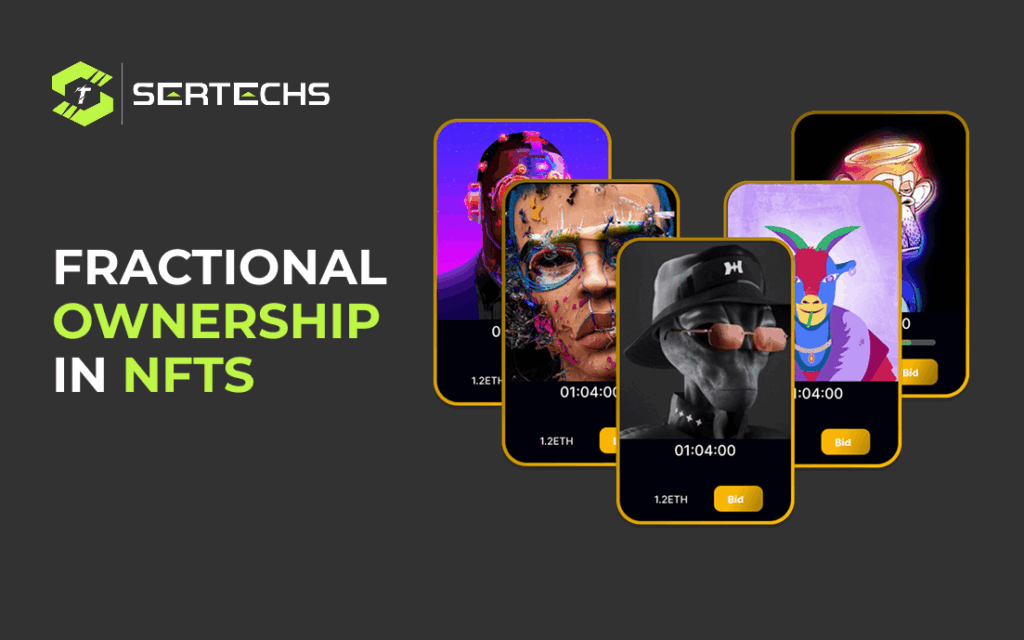
Fractional ownership in NFTs refers to the practice of dividing ownership of an NFT into smaller, tradable shares or fractions. This concept allows multiple individuals to collectively own and invest in high-value NFTs, such as digital art, collectibles, virtual real estate, or other digital assets. Fractional ownership is achieved by tokenizing the ownership rights and distributing these tokens to different investors. Here’s how fractional ownership of NFTs typically works: Tokenization: The NFT representing the digital asset is divided into smaller, fungible tokens that can be owned and traded individually. These tokens are often called “fractions” or “shares.” Smart Contracts: Smart contracts, often based on blockchain technology (such as Ethereum), are used to manage the fractional ownership. The smart contract defines the rules for ownership, transfers, and distribution of proceeds. Ownership Distribution: These fractions of the NFT are then sold or distributed to different investors. Each investor receives a certain number of tokens representing their share of ownership in the NFT. Governance and Decision-Making: Some systems also implement governance tokens, allowing fractional owners to collectively make decisions regarding the NFT, such as whether to sell it, loan it, or use it in some way. Trading and Liquidity: Fractional NFT ownership makes it easier for investors to buy and sell shares of high-value NFTs, thereby providing more liquidity in the market. Platforms or marketplaces that support fractional ownership often facilitate these trades. Fractional ownership of NFTs has several advantages: Accessibility: It allows smaller investors to participate in the ownership of valuable NFTs that they may not be able to afford outright. Diversification: Investors can diversify their NFT portfolios by owning fractional shares in multiple assets. Liquidity: Fractional ownership increases the liquidity of the NFT market, making it easier to trade and exit investments. Collective Decision-Making: It allows a community of investors to make decisions about the NFT’s use, sale, or other actions collectively. There are also some challenges and considerations: Regulatory Compliance: Fractional ownership may be subject to legal and regulatory scrutiny, depending on the jurisdiction, especially when it involves securities laws. Governance Disputes: Decisions made by a community of fractional owners can lead to disputes and disagreements. Security: The smart contracts and platforms used for fractional ownership must be secure to prevent hacks and unauthorized transfers. Fractional ownership in NFTs is an evolving concept, and it’s essential for investors and market participants to be aware of the associated risks and legal considerations while exploring this investment avenue.
Crypto Art
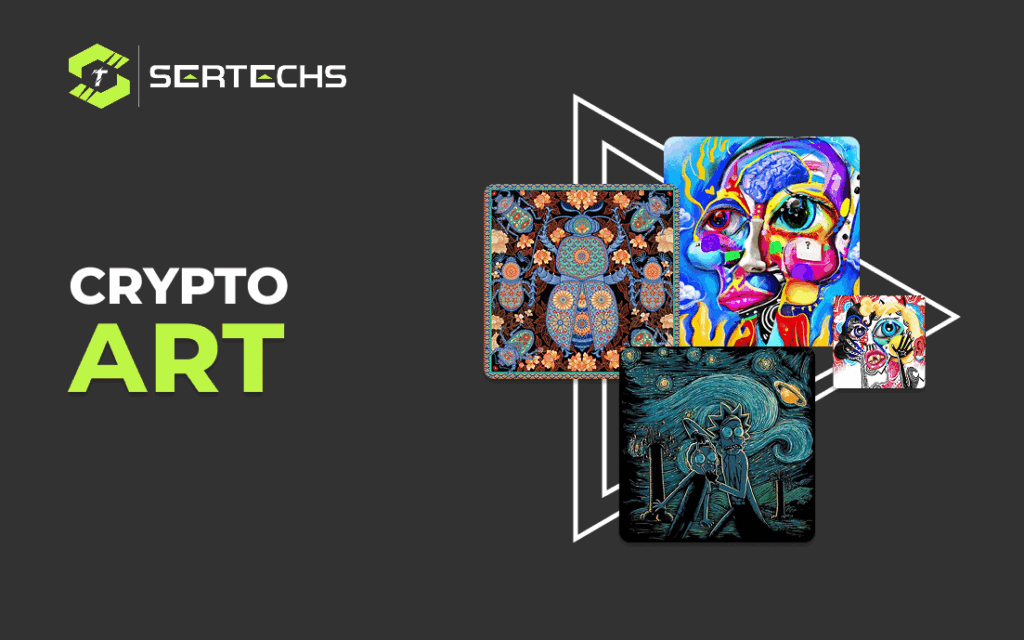
Crypto art, also known as digital or NFT (Non-Fungible Token) art, is a relatively new and rapidly growing form of art that leverages blockchain technology to create, sell, and authenticate digital artworks. NFTs are unique digital tokens that represent ownership of a specific digital item or piece of art. Here are some key aspects of crypto art: Digital Art: Crypto art consists of digital artworks, which can take various forms, including images, animations, videos, music, and more. These artworks are typically created and stored in digital formats. Non-Fungible Tokens (NFTs): Each piece of crypto art is associated with a unique NFT, which is minted on a blockchain. NFTs are indivisible and cannot be exchanged on a one-to-one basis, unlike cryptocurrencies like Bitcoin or Ethereum, which are fungible. Blockchain Technology: The ownership and provenance of crypto art are recorded on a blockchain, providing a transparent and immutable ledger of the artwork’s history. Ethereum is one of the most commonly used blockchains for minting NFTs, but others like Binance Smart Chain and Flow are also used. Ownership and Provenance: NFTs certify ownership of the digital art piece and enable the tracking of its history, including sales and transfers, ensuring its authenticity. Ownership and Copyright: While owning an NFT gives you ownership of the digital file, it does not necessarily grant copyright or reproduction rights to the buyer. Copyright and licensing terms should be considered separately from NFT ownership. Marketplaces: Various online marketplaces, such as OpenSea, Rarible, and SuperRare, facilitate the creation, sale, and purchase of crypto art. These platforms also enable artists to tokenize their digital creations. Artists and Collectors: Crypto art has attracted both established and emerging artists, as well as collectors who are interested in the novelty of owning digital art. Some artists have found newfound success in this space, while others remain skeptical of the new technology. Environmental Concerns: The energy consumption of some blockchain networks used for NFTs, such as Ethereum, has raised environmental concerns. This is due to the energy-intensive process of minting NFTs and validating transactions on these networks. Crypto art has generated a great deal of attention and controversy within the art world, and its long-term impact on the art industry and the concept of ownership is still a subject of debate. While some view it as a revolutionary way for artists to gain recognition and monetize their digital works, others question its environmental impact, authenticity, and speculative nature. As the space continues to evolve, it’s essential for both artists and collectors to exercise caution and due diligence in this rapidly changing ecosystem.
Social Metaverse
The term “Social Metaverse” refers to a digital, interconnected, and immersive virtual space where people can interact, socialize, work, play, and create in a shared online environment. It builds upon the concept of a metaverse, which is a virtual reality space or collective virtual shared space that spans multiple digital platforms, and extends the focus to the social aspects of this virtual world. Key characteristics and features of a social metaverse include: Immersive Environments: Users can engage in a 3D or highly immersive virtual environment. These environments may be accessed through virtual reality (VR) or augmented reality (AR) headsets, or even on traditional screens. Social Interaction: A central aspect of the social metaverse is social interaction. Users can communicate with each other through avatars, chat, voice, and video, much like in the physical world. User-Created Content: Users can create and manipulate their environments, objects, and avatars. User-generated content plays a significant role in shaping the metaverse. Economy and Commerce: It often includes a virtual economy with its own currency, assets, and goods. Users can buy, sell, trade, or even create virtual products and services. Diverse Use Cases: It serves as a platform for various purposes, including gaming, entertainment, education, remote work, social gatherings, and more. Interoperability: Different platforms and applications within the social metaverse can interact and connect with each other, allowing users to seamlessly transition between experiences. Privacy and Security: It must address privacy and security concerns, as users share personal information and engage in real-life-like interactions. Accessibility: Efforts are made to ensure that the metaverse is accessible to a wide range of users, regardless of their physical abilities or the technology they have access to. The concept of the social metaverse has gained significant attention from technology companies, with major players investing in the development of virtual worlds and platforms that aim to bring people together in a shared digital space. These companies are working on creating interconnected ecosystems that bridge the virtual and physical worlds, with the goal of enhancing collaboration, entertainment, and social interactions in a digital space. However, it’s worth noting that the development and realization of the social metaverse are ongoing processes, and there are challenges to overcome, such as issues related to ethics, privacy, and digital rights. Additionally, the concept may continue to evolve as technology advances and societal expectations change.
NFT Gaming
NFT (Non-Fungible Token) gaming is a rapidly growing sector in the video game industry that combines blockchain technology and digital assets. NFTs are unique, indivisible tokens that represent ownership of a specific digital or physical item. In the context of gaming, NFTs are typically used to represent in-game assets, characters, skins, weapons, and other digital items. Here’s an overview of NFT gaming: Ownership and Scarcity: NFTs in games give players true ownership of in-game assets. Unlike traditional games where items are stored on centralized servers, NFTs are recorded on a blockchain, ensuring the scarcity and uniqueness of each item. This means that players can buy, sell, and trade in-game assets as they would with physical items. Interoperability: Some NFT games allow players to transfer their in-game assets between different games or platforms, creating a more open and interconnected gaming ecosystem. Provenance and Authenticity: It provides a transparent and verifiable history of in-game assets. Players can trace the origin and ownership history of their items. Player-Centric Economies: NFT gaming enables player-driven economies. Players can earn real-world value by selling their in-game assets, which has led to the emergence of professional gamers and in-game entrepreneurs. Decentralization: NFT games often use blockchain technology, which is decentralized and secure. This reduces the risk of fraud and hacking, and players have greater control over their assets. Challenges and Concerns: NFT gaming is not without controversy. Some concerns include environmental issues (many blockchains consume significant energy), speculation and price volatility, scams and fraudulent projects, and exclusionary barriers to entry for players with limited financial means. Popular NFT Gaming: Some popular games as of my last update in September 2021 include “Axie Infinity,” “Decentraland,” “The Sandbox,” and “CryptoKitties.” However, the NFT gaming space is rapidly evolving, and new games are constantly being developed. Licensing and Copyright: The use of NFTs in gaming has raised questions about copyright and intellectual property rights, as game developers and publishers seek to control the use of their game assets in this new paradigm. NFT gaming has the potential to revolutionize how players interact with virtual worlds and in-game assets. However, its future depends on how the technology evolves and how it addresses the challenges and concerns that have been raised.
Metaverse
The term “metaverse” refers to a virtual or digital universe, typically built on the foundation of the internet and various technologies like augmented reality (AR) and virtual reality (VR). The concept of a metaverse has been popularized in science fiction, but it has gained significant attention in recent years as technology has advanced. Here are some key points to understand about the metaverse: Digital Universe: It is essentially a collective virtual shared space that encompasses various interconnected digital environments, platforms, and experiences. It’s not limited to a single application or game but rather a vast and immersive digital realm. Interconnected: In the metaverse, different virtual spaces, worlds, and experiences are interconnected, allowing users to move between them seamlessly. This interconnectedness enables a wide range of social, economic, and creative activities. User Interaction: Users typically engage with the metaverse through avatars, which represent them in the digital space. These avatars can interact with other users, objects, and environments, often in real-time. Multi-Purpose: It has diverse applications, including gaming, social interactions, education, virtual workplaces, entertainment, commerce, and more. It can be a space for both leisure and productivity. Technology Enablers: The development and expansion of the metaverse are made possible by various technologies, including VR headsets, AR devices, cloud computing, high-speed internet, blockchain for virtual assets, and artificial intelligence for creating immersive experiences. Economic Implications: It has the potential to create new economic opportunities. Virtual goods and services can be bought and sold within the metaverse, and there’s a growing interest in creating digital assets and virtual real estate. Challenges: The metaverse concept also raises significant challenges, including privacy concerns, digital security issues, and the need for robust content moderation. Additionally, it raises questions about digital identity and who controls these virtual spaces. Prominent Companies: Several major technology companies are actively exploring and investing in the metaverse, including Facebook (now Meta), Microsoft, Google, and smaller startups in the VR and AR space. Cultural and Social Impact: It has the potential to reshape how people interact, socialize, work, and play. It could influence everything from art and entertainment to politics and education. It’s important to note that while the concept of the metaverse is exciting, it is still in its early stages of development. The full realization of a true metaverse may take several years or even decades, as it requires overcoming various technical, social, and economic challenges.
NFT Marketplaces
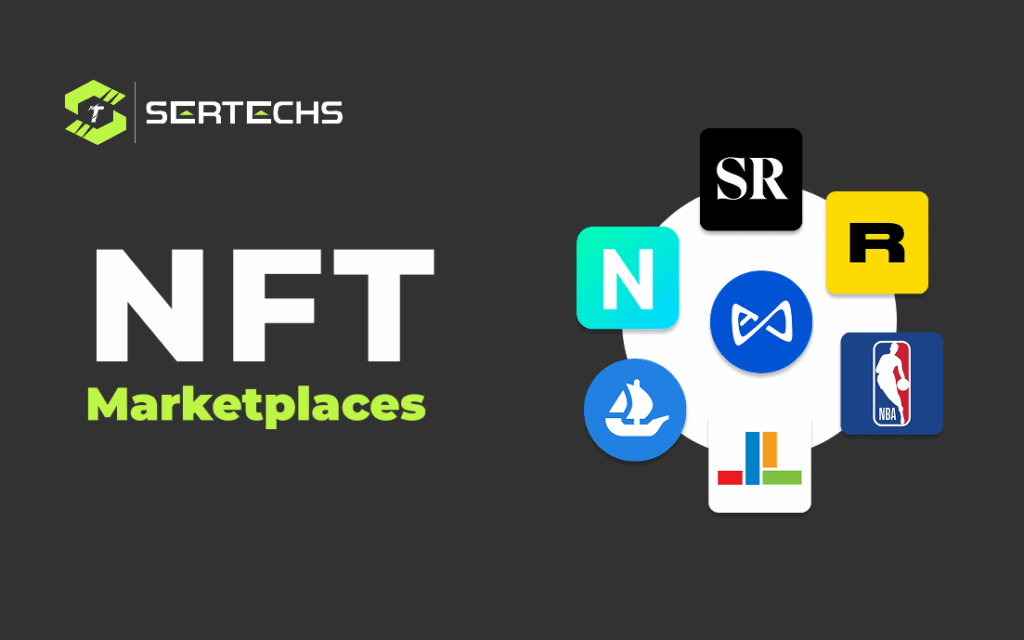
Non-fungible tokens (NFTs) have gained immense popularity as a form of digital asset ownership and representation. NFTs are unique digital tokens that are indivisible and represent ownership or proof of authenticity of a digital or physical item. NFT marketplaces are online platforms where users can buy, sell, and trade NFTs. Here are some notable NFT marketplaces: OpenSea: OpenSea is one of the most popular NFT marketplaces. It supports a wide range of digital assets, including art, collectibles, virtual real estate, and more. Axie Infinity Marketplace: Axie Infinity is a blockchain-based online game that combines elements of collecting, battling, and trading. In this game, players collect and breed fantasy creatures known as Axies. These Axies are represented as NFTs, and the Axie Infinity Marketplace is where players can buy, sell, and trade these digital creatures. NBA Top Shot Marketplace: NBA Top Shot is a blockchain-based platform officially licensed by the National Basketball Association (NBA) that allows fans to buy, sell, and trade officially licensed NBA collectible highlights. These highlights are represented as NFTs, and they capture iconic moments from NBA games. Rarible: Rarible is a decentralized marketplace where users can create and trade NFTs. It is known for its governance token, $RARI, which allows users to have a say in platform decisions. SuperRare: SuperRare is a marketplace primarily focused on digital art. It enables artists to tokenize their work and sell it to collectors. Foundation: Foundation is a creative platform and marketplace where artists can create and sell NFTs. It emphasizes the idea of “unlocking creativity” and community support. CryptoPunks: CryptoPunks is one of the early NFT projects on the Ethereum blockchain. It features unique 10,000 algorithmically generated 24×24 pixel art characters. Nifty Gateway: Nifty Gateway offers a unique approach by hosting “Nifty Drops” where artists release their NFT collections in timed events. It aims to make NFTs accessible to a broader audience. ThetaDrop: ThetaDrop is part of the Theta Network, a blockchain-powered video streaming platform. It focuses on NFTs related to esports, gaming, and media. Please note that the NFT space is highly dynamic, and new marketplaces may have emerged since my last update. Additionally, the popularity and trustworthiness of NFT marketplaces can change over time, so it’s essential to do your research and exercise caution when using these platforms. Always verify the authenticity of NFTs and their creators before making any purchases.
NFTs
NFTs, or Non-Fungible Tokens, are a type of digital asset that represents ownership or proof of authenticity of a unique item or piece of content using blockchain technology. Unlike cryptocurrencies like Bitcoin or Ethereum, which are fungible and can be exchanged on a one-to-one basis, NFTs are non-fungible, meaning each NFT has a distinct value and cannot be exchanged on a like-for-like basis with another NFT. Key characteristics of NFTs include: Uniqueness: Each NFT is one-of-a-kind or limited in supply, making it distinct from other tokens. This uniqueness is typically used to represent ownership of digital or physical assets, digital art, collectibles, music, videos, virtual real estate, in-game items, and more. Ownership and Provenance: NFTs are secured by blockchain technology, which ensures ownership and provenance by recording each transaction in a public ledger. This ledger makes it easy to verify the authenticity and ownership history of the NFT. Indivisibility: NFTs cannot be divided into smaller units like cryptocurrencies. They are bought, sold, and owned as whole tokens. Interoperability: NFTs can be used on various platforms and applications, enabling creators and users to integrate them into different digital ecosystems. Provenance and Authenticity: One of the most significant advantages of NFTs is the ability to prove the authenticity and ownership history of a digital asset. Each NFT contains a unique identifier and is recorded on the blockchain, which serves as an immutable ledger. This transparency can help combat issues related to counterfeit goods and art fraud. Ownership Transfer: NFTs can be bought, sold, and traded on various online marketplaces and platforms that support NFT transactions. When you purchase an NFT, the ownership rights are transferred to your blockchain wallet. You can then choose to hold onto the NFT, sell it, or transfer it to another wallet. Interoperability: NFTs are designed to be interoperable, meaning they can be used across multiple platforms and applications. For example, an NFT representing virtual real estate in one game might be usable in another game that supports the same blockchain. Smart Contracts: Smart contracts associated with NFTs can include specific conditions, such as royalties for creators. This means that creators can continue to earn a portion of the sale price when their NFT is resold in the secondary market. Environmental Concerns: Some blockchain networks, particularly Ethereum, use a Proof of Work (PoW) consensus mechanism, which is energy-intensive. This has raised environmental concerns about the carbon footprint of NFTs. Efforts are being made to transition to more environmentally friendly blockchain technologies, such as Proof of Stake (PoS). Legal and Copyright Issues: The NFT space is still evolving, and there can be legal and copyright concerns, especially when tokenizing digital content that may be subject to intellectual property rights. Creators and buyers should be aware of these potential issues. NFTs have generated significant interest and have disrupted various industries, but their long-term impact and sustainability continue to be subjects of debate and development. As with any emerging technology, it’s crucial to exercise caution and conduct due diligence when participating in the NFT market.
Blockchain Framework

A blockchain framework is a foundational structure or architecture that provides the necessary tools, protocols, and libraries for building and operating blockchain-based applications and networks. Blockchain frameworks serve as a basis for creating, deploying, and managing blockchain technology. These frameworks are essential for developers and organizations interested in creating their own blockchain solutions or working with existing blockchain networks. Here are some commonly used blockchain frameworks: Hyperledger Fabric: Hyperledger Fabric is an open-source blockchain framework hosted by the Linux Foundation. It is designed for enterprise use cases and provides modularity, permissioned networks, and support for smart contracts. Fabric allows organizations to create private, consortium, or public blockchains. Ethereum: Ethereum is an open-source blockchain platform and framework for building decentralized applications (DApps). It supports smart contracts, which are self-executing contracts with the terms of the agreement directly written into code. Corda: Corda is an open-source blockchain platform developed by R3. It is designed for financial institutions and focuses on enabling direct, private transactions between parties. Corda is particularly suited for managing financial agreements. Quorum: Quorum is an enterprise-focused blockchain framework built on Ethereum. It’s designed to provide privacy and data confidentiality, making it suitable for financial and supply chain applications. Stellar: Stellar is an open-source framework designed for cross-border payments and asset issuance. It emphasizes fast and low-cost transactions, making it ideal for financial applications. EOSIO: EOSIO is an open-source blockchain framework for developing scalable DApps. It focuses on providing high throughput and is often used for applications where speed and scalability are crucial. Tezos: Tezos is a self-amending blockchain framework that allows for on-chain governance. It aims to provide a platform for smart contracts and DApps with a focus on security and upgradability. Avalanche: Avalanche is a consensus mechanism and blockchain framework designed for high performance and scalability. It offers a variety of blockchain deployment options, making it versatile for different use cases. Binance Smart Chain (BSC): Binance Smart Chain is a blockchain framework that is compatible with Ethereum, allowing developers to port Ethereum DApps to BSC for lower transaction fees and higher throughput. These blockchain frameworks provide developers and organizations with the tools and infrastructure needed to create custom blockchain applications or participate in existing blockchain networks. The choice of framework depends on the specific requirements of the project, such as scalability, privacy, consensus mechanisms, and the target use case.